
For a while now, meditation has been a buzz word. Every other conversation either starts or ends with, “Have you started meditating?” or “Bro, how do I meditate?”
But, before we even get started, we have to ask ourselves, what is our linear understanding of meditation?
In short, it is this: finding a clean and calm spot, sitting cross-legged on a fluffy or comfortable meditation cushion, closing our eyes and just desperately hoping that our thoughts stop bothering us and we are able to concentrate on either nothingness or oneness (both of which sort of don’t make sense).
Now, let me ask you this: Do you just wake up one day and decide to run a marathon or do you work on your mind, body and skills everyday to build your stamina, strength and focus (emotional and mental)? Most people would say the latter. So, why not apply this same principle to meditation too?
If you look at ancient yogic principles written by the father of Yoga himself, Maharishi (great saint) Patanjali, you’ll come to realise that to meditate and sit in one place with absolute calm and unbridled concentration is a process for which the body and mind have to be prepared systematically.
None of us are superheroes, especially in the day and age we live in today where we are slaves of dopamine (provided by a multitude of short-form content available on social media). Therefore, to meditate, you have to follow the process carefully and climb the ladder one step at a time. You can try sprinting, but that won’t help with finishing the marathon. It might lead to injury though, so be careful.
So then, what is the process to start meditation?
In the Indian text of Yogic Sciences written by Maharishi Patanjali, The Yoga Sutras of Patanjali, the guru discusses the process of Ashtanga Yoga or the eight limbs of Yoga by which one can attain salvation. Now, even if you just want to meditate and don’t care about salvation, keep reading. You’ll find your answer, I promise.
This text contains 196 sutras (literary rule or aphorism) which are divided into four chapters or padas (parts or quarters). They are: Samadhi Pada (on contemplation), Sadhana Pada (on practice), Vibhuti Pada (on properties and powers) and Kaivalya Pada (on emancipation and freedom). While each of these chapters dive deeper and deeper into the subtle and very real aspects of the self in connection with the brahman (universe/existence), in this article, we will specifically only discuss the 8 limbs of Yoga in an introductory manner.
The 8 limbs of Ashtanga Yoga
In sutra 11.29, maharishi Patanjali mentions the 8 limbs of Ashtanga Yoga. The sutra reads:
yama niyama Asana pranayama
pratyahara dharana dhyana
samadhayah astau atgani
This is what the sutra means i.e. the 8 limbs of Yoga are:
- Yama (self-restraint, vows of abstention, control)
- Niyama (fixed observances, fixed rules, precepts, established order, law)
- Asana (sitting in various postures, seat in general, a posture)
- Pranayama (regulation of breath, restraint of breath)
These first 4 limbs of Yoga help the practitioner with the discovery of the self and its true nature. It also encourages the practitioner to observe and modify their everyday behaviour.
5. Pratyahara (retreat, withdrawal of the senses)
6. Dharana (the act of concentration, act of holding, keeping the mind collected)
7. Dhyana (meditation, contemplation, reflection, attention)
8. Samadhi (putting together, collection, composition, profound meditation, absorption, superconsciousness)
These last 4 aspects of Yoga comprise of the inward journey of Yoga which “detaches the consciousness from external sense objects.” It does this by silencing the voice and tendencies of the individual ego (here, meaning sense of identity) and the 5 senses of the human self which helps the practitioner realise the soul aspect within themselves.
Conclusion
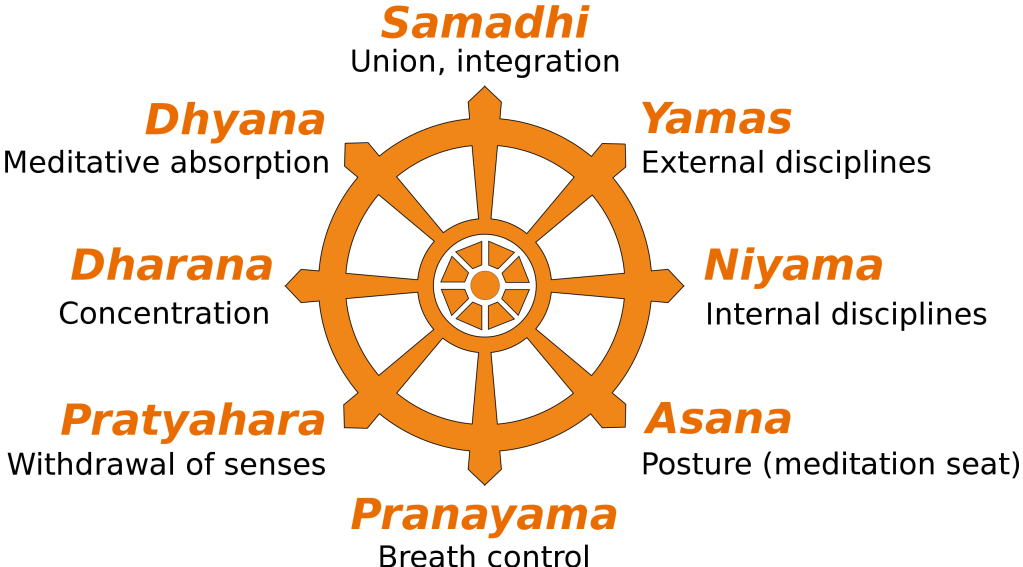
Graph by Ian Alexander under Creative Commons license CC BY-SA 4.0
These 8 limbs of Ashtanga Yoga are ascribed with certain do’s and don’ts that the practitioner has to follow. As the practitioner evolves from one level to the next, he/she reaches closer to their destination of salvation, or in our case, the ability to meditate.
Therefore, when we sit down and try to meditate without completing or even pondering on the levels before that, we are doing ourselves a disservice because our sense of being is not only limited to the physical body.
As the yogic texts here mention, mediation comes in level 7 and we have much base to cover before getting there.
Many other sacred texts across India and the Yoga Sutras of Patanjali also mention that we are the complete package of our emotional, mental, subtle, physical and supra-natural states. Looking at one without the other doesn’t make sense and this is precisely why a definite systematic and holistic process was developed to achieve the overall well-being of any individual.
We will look into each of these limbs in detail in the next article. Stay tuned!
Source: Light on the Yoga Sutras of Patanjali by B.K.S. Iyengar
This article is the copyright work of the author and this blog.

 The Topical Mill
Leave a comment